
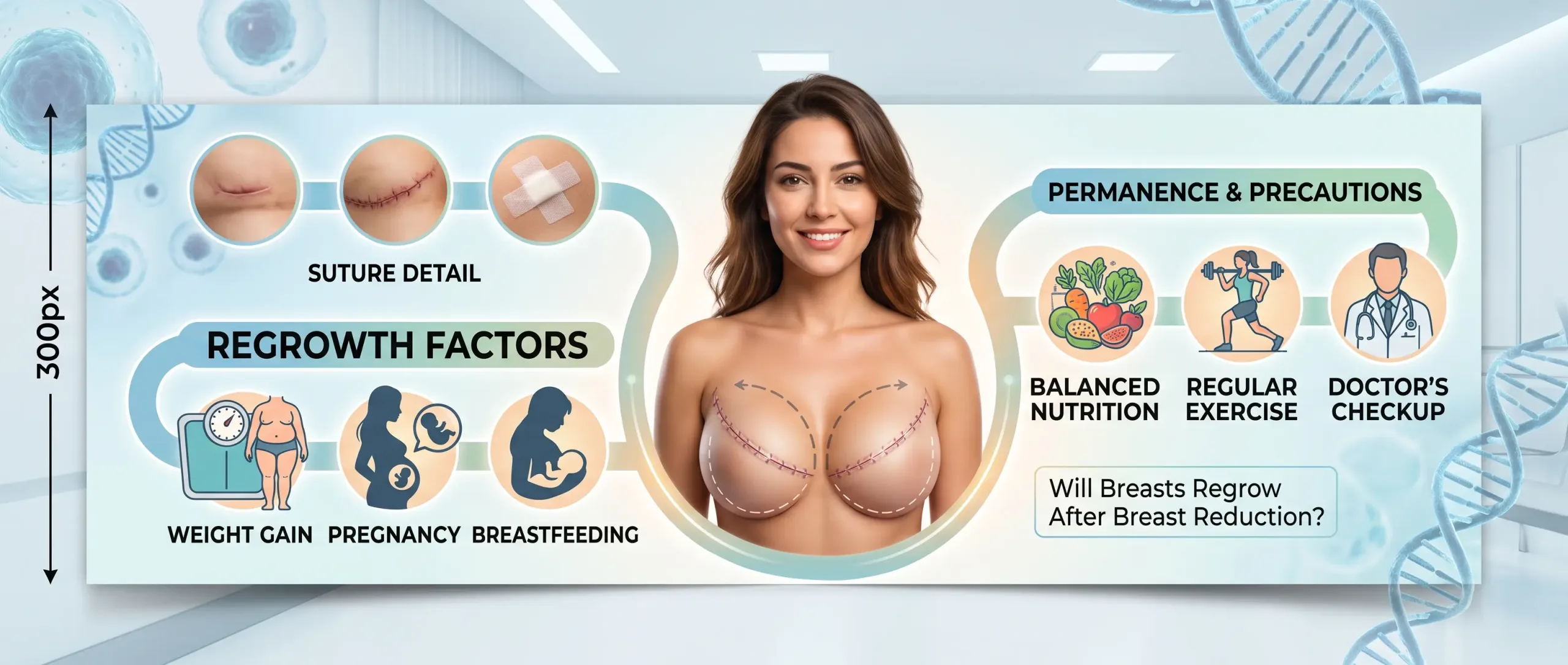
Do Breasts Grow Back After Breast Reduction Surgery

Do Breasts Grow Back After Breast Reduction Surgery?

Ana sayfa » Blog » Breast Surgery » Do Breasts Grow Back After Breast Reduction Surgery?

By undergoing breast reduction surgery (reduction mammaplasty), you have finally freed yourself from chronic back pain, heavy shoulders, and achieved the proportional body of your dreams. However, there is one critical question that naturally crosses the minds of many patients: "If I gain weight in the future, will my breasts grow back to their old, massive, and painful size? Will my surgery have been in vain?"

Let’s give you the short and definitive answer right away: No, your breasts will never return to their extremely large, pre-surgery state. But how is this medically guaranteed? Let’s take a closer look at breast anatomy and the science of fat cells based on the clinical expertise of Op. Dr. Ali Mezdegi.

What is Breast Tissue Made Of, and What Happens During Surgery?

To understand the logic behind the process, we need to look at breast anatomy. In women, the breast structure is primarily composed of two main elements: the mammary glands (glandular tissue) and fat tissue.

During breast reduction surgeries, aesthetic surgeons completely remove a significant amount of both the volume-creating mammary glands and the excess fat tissue from your body. The remaining healthy tissue is then reshaped and lifted (mastopexy) to achieve its ideal, youthful form.

Will My Breasts Grow Again If I Gain Weight?

If you gain weight after the surgery, it is completely normal for your breasts to experience a slight increase in volume. However, this growth does not mean they will return to their old size. The scientific reason is quite simple:

  • When the human body reaches adulthood, the number of fat cells stabilizes. This means when you gain weight, you do not produce new fat cells; the existing fat cells simply expand (swell) in diameter.
  • During a breast reduction surgery, a large percentage of the fat cells in your breasts are surgically and permanently removed from your body.
  • Therefore, even if you continue to gain weight after the operation, the number of fat cells left to expand is so small that your breasts can never reach their pre-surgery size.

Will I Ever Need a Second Surgery?

One of the most common concerns among international patients is, "Will I need to have this surgery again in a few years?" As Op. Dr. Ali Mezdegi emphasizes, breast reduction surgeries generally do not need to be repeated.

Let’s assume that after the surgery, you achieve an ideal, well-proportioned breast size (e.g., a standard C or D cup, depending on your body frame):

Even if you gain 5 kg, 10 kg, or 15 kg (10 to 30 lbs) post-surgery, you will not experience any aesthetic or functional issues with your breasts. In an extreme case where you gain a significant amount of weight, such as 20 kg (45 lbs), you might notice your cup size increasing slightly. However, even this volume increase will not bring back your old massive breasts, and it will certainly not reach a size that requires a second reduction surgery.

In summary; the results of a breast reduction operation are highly permanent and satisfying. There is absolutely no need to postpone this life-enhancing surgery out of fear of future weight gain.

Frequently Asked Questions: Permanence of Breast Reduction
If you gain a significant amount of weight (like 15-20 kg / 30-45 lbs), the remaining fat cells will expand, causing a slight increase in volume. However, your breasts will never return to their pre-surgery massive size.
No. In an adult body, the number of fat cells is fixed and they do not regenerate. When you gain weight, only the volume (diameter) of the remaining fat cells expands.
During pregnancy, hormonal changes cause the mammary glands to swell, resulting in some breast enlargement. However, this growth will not reach your pre-surgery measurements. After breastfeeding concludes, the breasts tend to shrink back.
If you lose a significant amount of weight, the fat volume in your breasts will decrease, which might cause a slight reduction in size and mild skin laxity (sagging). Ideally, you should maintain a stable weight.
Unless extreme hormonal disorders or severe obesity develop, a second breast reduction surgery is rarely needed. Even if you gain weight, your breasts will not reach aesthetically or functionally troublesome sizes.
Since the fat and glandular tissues are permanently removed by the surgeon, the results are essentially lifelong. However, the natural loss of skin elasticity over time due to aging and gravity is a normal physiological process.
Weight gain directly increases the volume of fat cells. Mammary glands (glandular tissue) do not respond much to weight gain; they primarily grow during hormonal shifts like pregnancy and lactation.
With your doctor's approval, you can generally start light exercises like cardio and fitness within 4 to 6 weeks, provided you wear a supportive sports bra.
During menopause, as estrogen levels drop, the mammary glands shrink, and the proportion of fat in the breasts increases. If you gain significant weight during this period, your breasts may increase in volume, but you will still not revert to your pre-surgery size.
The most guaranteed way to maintain your new lifted, proportionate, and healthy breast shape for many years is to keep your ideal weight stable (within a +/- 3-5 kg range) and always support your breasts with proper sports bras during physical activities.
Op. Dr. Ali Mezdegi - Plastic Surgeon Istanbul

Author: Op. Dr. Ali Mezdegi

Aesthetic and Plastic Surgery Specialist

With 25 years of experience in aesthetic and reconstructive breast surgery, Op. Dr. Ali Mezdegi provides world-class care in Istanbul, Turkey. He is dedicated to creating permanent solutions that focus not only on cosmetic appearance but also on the anatomical validity, body proportions, and long-lasting permanence of the results.

🩺
Medical Review & Approval: The content of this guide on "Do Breasts Grow Back After Breast Reduction Surgery?" was last updated on August 29, 2026. It has been meticulously reviewed and approved for medical accuracy, anatomical validity, and current surgical standards by Aesthetic and Plastic Surgery Specialist Op. Dr. Ali Mezdegi.