



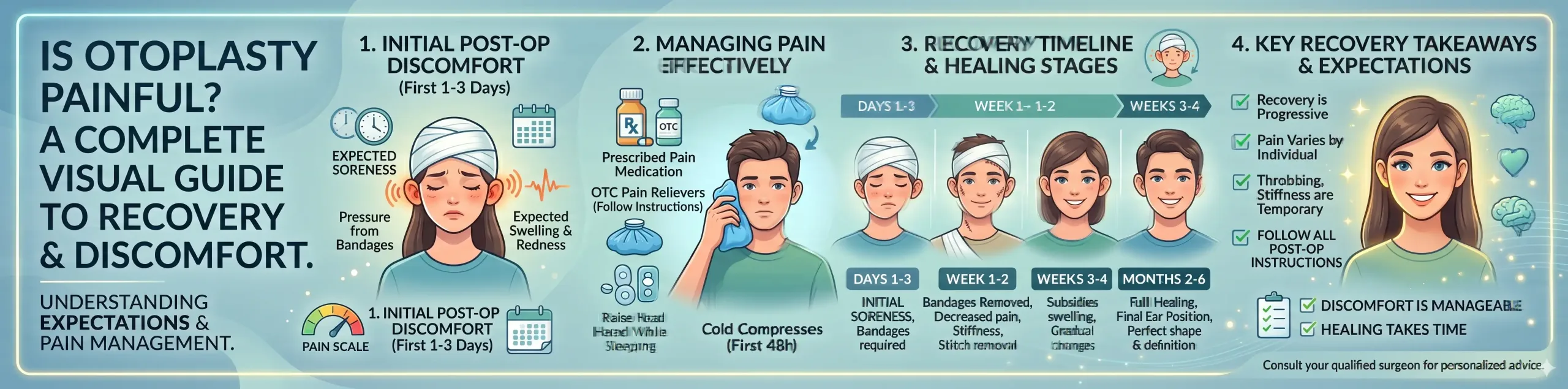
Is Otoplasty Painful?
Ana sayfa » Blog » Blog » Otoplasty Surgery » Is Otoplasty Painful?
When considering ear pinning surgery, the most common question patients ask is, “Is otoplasty painful?” The reassuring truth is that otoplasty is considered one of the most comfortable and pain-free cosmetic procedures available today. Because the surgery exclusively targets the outer ear cartilage, there is no need for heavy general anesthesia. Instead, the area is completely numbed using a highly effective local anesthetic. Once the anesthetic takes effect in a matter of seconds, your ears become entirely numb. The area is so deeply anesthetized that you wouldn’t feel the slightest pinch or pain, regardless of the surgical steps being performed. You will remain awake, entirely comfortable, and can even listen to your favorite music while the surgeon works.
But what happens after the surgery when the numbness finally wears off? This is another area where patient fears often exceed reality. The post-operative discomfort is surprisingly mild. Under the expert care of Op. Dr. Ali Mezdeği at Esteport Clinic in Turkey, you are provided with a carefully tailored medical kit that includes specific painkillers and preventive antibiotics. By taking these prescribed medications as directed, any potential throbbing or soreness is reduced to an absolute minimum—often described by patients as just a mild, temporary tenderness rather than actual pain. Within a day or two, you will feel perfectly fine to enjoy your medical holiday in beautiful Istanbul.
But what happens after the surgery when the numbness finally wears off? This is another area where patient fears often exceed reality. The post-operative discomfort is surprisingly mild. Under the expert care of Op. Dr. Ali Mezdeği at Esteport Clinic, a premier destination for ear surgery in Turkey, you are provided with a carefully tailored medical kit that includes specific painkillers and preventive antibiotics.
By taking these prescribed medications as directed, any potential throbbing or soreness is reduced to an absolute minimum—often described by patients as just a mild, temporary tenderness rather than actual pain. Within a day or two, you will feel perfectly fine to enjoy your medical holiday in beautiful Istanbul.
🌡️ The Otoplasty Pain Scale (1 to 10)
Wondering exactly what you will feel and when? Here is a realistic breakdown of the discomfort levels during your ear pinning journey in Istanbul.
The Numbing Injection (First 10 Seconds)
A tiny micro-needle is used behind the ear. You will feel a quick, mild pinch similar to a mosquito bite, followed by a warm sensation. It lasts only seconds.
During the Surgery (1 Hour)
Absolute zero pain. The ear is 100% deeply numbed. You might feel a slight pressure or touch, but absolutely no sharp sensations. You can relax and listen to music.
The First Night (Anesthesia Wears Off)
As the numbing fades, you will experience a dull ache or a "throbbing" sensation. This is the peak of discomfort, but our prescribed painkillers easily and quickly neutralize it.
Days 2 to 3 (Exploring Istanbul)
The throbbing is gone. Your ears will just feel slightly tender or tight if accidentally touched. You will feel physically great and can walk around the city comfortably.
Bandage Removal & Check-up
Taking off the surgical bandages does not hurt at all. In fact, patients report a massive sense of physical relief and joy when they see their new ears in the mirror.
▶ Hear It From Our Patients: Zero Pain
Still anxious? Watch our real patients describe their completely pain-free experiences during and after their ear pinning surgery in Istanbul.
Will There Be Pain After Otoplasty?
Listen to a firsthand account of the post-operative recovery phase, proving how mild, manageable, and comfortable the healing process truly is.
Is It Painful? This Patient Says NO!
A real patient shares her awake surgery experience, confirming that local anesthesia makes the entire 1-hour procedure completely comfortable and pain-free.
The Numbing Process: Does the Injection Hurt?
The most significant barrier for many patients considering awake otoplasty is needle phobia. It is entirely normal to be anxious about getting an injection near your ear. However, the reality is far less intimidating than your imagination.
At Esteport, Dr. Ali Mezdeği uses ultra-fine micro-needles—significantly thinner than standard blood-test needles. The injection is administered in the fleshy area behind the ear. For about 3 to 5 seconds, you will feel a tiny, sharp pinch—very similar to a quick mosquito bite or plucking an eyebrow hair. Almost instantly, a specialized numbing solution takes over, and the pinch is replaced by a warm, heavy sensation. Within a minute, your ear is completely deadened to any feeling. That 5-second pinch is the only “pain” you will experience during the entire clinical procedure.
What Will I Feel During the Surgery?
Once the local anesthesia has set in, your ear enters a state of profound numbness. Because we only operate on the outer cartilage and skin—never touching the inner ear or eardrums—the anesthesia is 100% effective.
You might be wondering, “If I am awake, what exactly will I feel?” You will feel tactile pressure, but zero pain. You will know that the doctor is touching your ear, but your brain will not register it as a painful stimulus. It is very similar to having a cavity filled at the dentist after your mouth is numbed; you feel the dentist working, but there is no sharp agony. You can keep your eyes open, chat with the surgical team, or simply put your earphones in, close your eyes, and listen to a podcast while your new ears are beautifully sculpted.
The First 24 Hours: Managing Post-Op Discomfort
The surgery is over, and you are back in your luxury hotel room in Istanbul. About 2 to 4 hours after the procedure, the local anesthesia will begin to gently wear off. This is the only phase where actual “discomfort” occurs.
You will not feel a sharp, cutting pain; instead, patients universally describe it as a dull, throbbing ache or a feeling of heat and tightness around the ears. This happens because the blood flow is returning to the reshaped cartilage. To ensure you do not suffer, our medical coordinators provide you with a comprehensive medication kit before you leave the clinic. By taking your prescribed anti-inflammatory painkillers as soon as you arrive at the hotel (before the numbness fully fades), you effectively block the throbbing before it even peaks. Most patients sleep through the first night comfortably with the help of these standard medications.
Why Dr. Mezdeği’s Technique Minimizes Pain
Not all surgical techniques yield the same recovery experience. Surgeries that involve aggressive cutting or removing large pieces of cartilage cause significant tissue trauma, which translates to severe swelling, heavy bruising, and intense pain during recovery.
Dr. Ali Mezdeği’s signature Anchor Technique is highly refined and minimally invasive. Instead of aggressively excising cartilage, he delicately scores and weakens the cartilage memory, folding it naturally and securing it with precise internal sutures. Because the tissue trauma is kept to an absolute minimum, the body’s inflammatory response is dramatically reduced. This means less swelling, virtually no bruising, and a remarkably fast, pain-free recovery that allows you to enjoy the rest of your trip in Turkey.
Zero Pain, Infinite Confidence: What’s Stopping You From Your Dream Look?
Now that fear and pain are completely out of the equation, the only thing standing between you and your ideal ear shape is a 60-minute playlist. Explore Op. Dr. Ali Mezdeği’s world-renowned Anchor Technique, browse our high-definition before-and-after gallery, and unlock all-inclusive Turkey packages tailored for your perfect transformation.
Will Flying Back Home Cause Ear Pain? (The Cabin Pressure Myth)
For international patients traveling to Istanbul, one of the biggest anxieties is the flight back home. Many patients worry that the changes in cabin pressure during takeoff and landing will cause excruciating pain in their newly operated ears.
Fortunately, this is a complete myth! Cabin pressure only affects the inner ear and the eardrum (which is why you normally swallow or chew gum on a flight to “pop” your ears). Otoplasty, however, is strictly an operation on the outer ear cartilage. Your eardrums and ear canals are completely untouched during the procedure. Therefore, flying back to the UK, USA, or Europe 2 to 3 days after your surgery will not cause any additional pain, pressure, or damage to your surgical results. You can sit back, relax, and enjoy your flight home with your new look.
Does Removing the Stitches Hurt? (And How to Sleep Pain-Free)
Another common fear is the follow-up appointment. Patients often ask, “Will it hurt when Dr. Mezdeği removes the stitches?” The great news is that for the internal shaping of the cartilage, Dr. Mezdeği uses permanent, deep anchor sutures that stay comfortably beneath the skin forever. For the external incision behind the ear, he typically uses dissolvable stitches or ultra-fine sutures that slide out without any resistance or pain during your final check-up on Day 3 or 4.
Once you return home, the only potential cause of pain is accidental physical pressure—specifically during sleep. Your ears will remain sensitive to heavy touch for a few weeks. To guarantee a pain-free recovery at home:
-
Sleep on Your Back: Use a travel neck pillow (U-shaped pillow) to prevent your head from rolling to the side while you sleep.
-
Wear the Headband: You must wear the soft sports headband provided by our clinic every night. This acts as a protective shield, preventing your ear from accidentally folding forward against the pillow, which would cause a sharp, sudden pain.
By following these simple sleeping rules, your recovery will remain as smooth and painless as the surgery itself.