



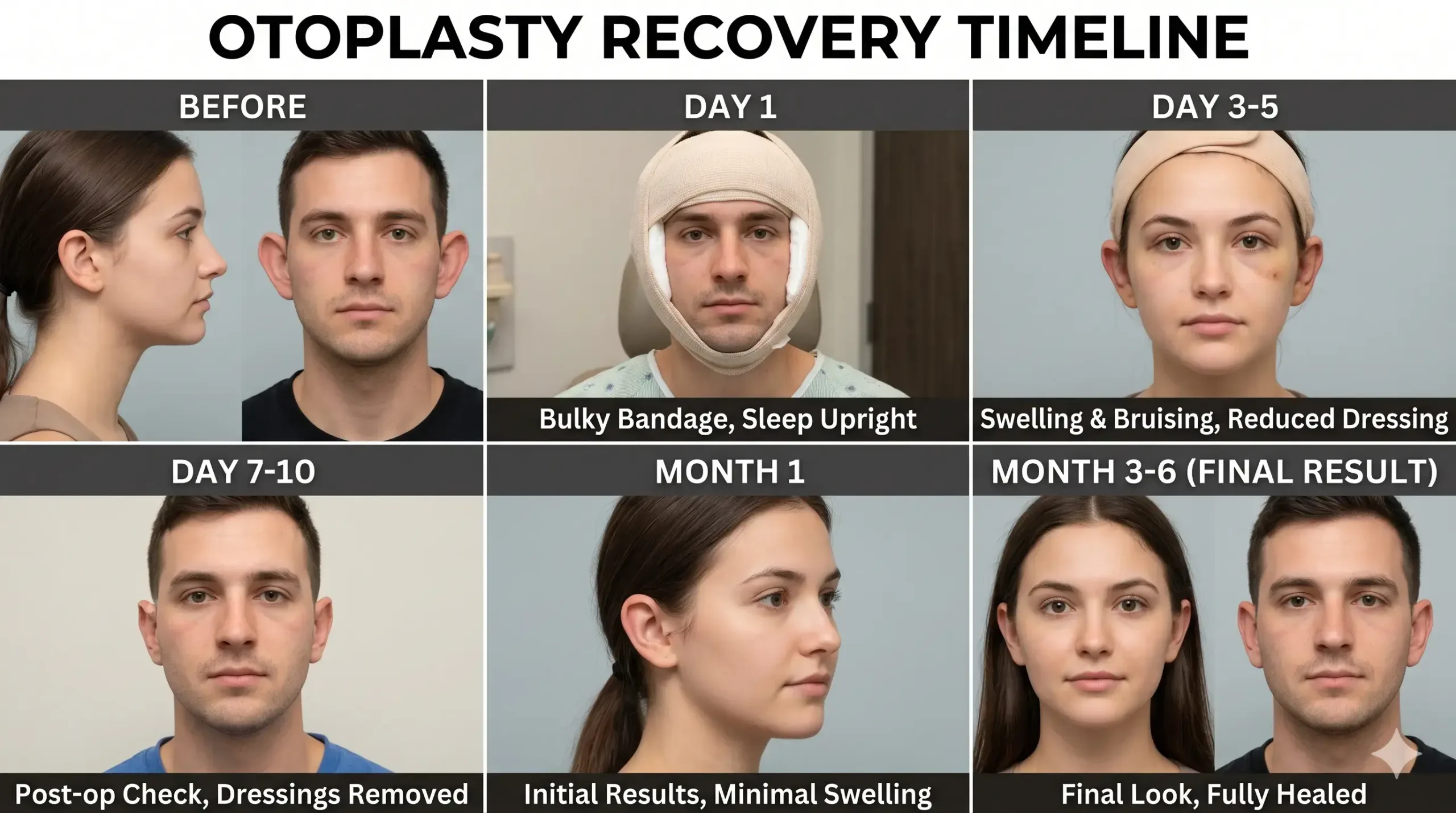
Otoplasty Recovery Day by Day
Ana sayfa » Blog » Blog » Otoplasty Surgery » Otoplasty Recovery Day by Day
When international patients travel to Esteport Clinic for ear pinning surgery, their primary concern is often the recovery process. How long will it take? When can I shower? What if they look too tight at first?
Op. Dr. Ali Mezdeği believes in 100% transparency. Based on his extensive surgical experience, we have outlined exactly what you will experience day by day following your otoplasty. Understanding the healing phases—especially the secret behind “overcorrection”—is the key to a stress-free recovery and a lifelong, natural result.
Op. Dr. Ali Mezdeği believes in 100% transparency. Based on his extensive surgical experience, we have outlined exactly what you will experience day by day following your otoplasty in Turkey.
Understanding the healing phases—especially the secret behind “overcorrection”—is the key to a stress-free recovery and a lifelong, natural result.
Quick Facts: Otoplasty Recovery Rules
Can I take a shower the day after surgery? You must wait exactly 48 hours until Dr. Mezdeği removes the initial medical bandage.
Do I have to wear the sports headband to work? For the first two weeks, you only need to wear the headband at night while sleeping.
Will my ears look "too tight" immediately after surgery? This is an intentional "overcorrection" because cartilage naturally relaxes and opens up slightly during healing.
Is it safe to fly back home shortly after? You are medically cleared to fly on Day 3 or Day 4. Airplane cabin pressure will not affect your ears.
Can I sleep on my side during the first few weeks? You must sleep on your back (a U-shaped neck pillow is highly recommended) to avoid pressure on the healing cartilage.
Can I go swimming on my summer holiday right after? You must strictly avoid pools and the sea for 4 to 6 weeks to prevent any risk of bacterial infection.
If my ear cartilage stubbornly relapses, is the revision free? Dr. Mezdeği offers a 100% free revision guarantee for the rare 2% of cases that require it after the 3-month mark.
▶ Hear It From The Expert & See The Journey
Listen to Dr. Ali Mezdeği’s transparent medical instructions and watch a real patient share their personal recovery experience just one month post-op.
Post-Operative Instructions
Dr. Ali Mezdeği explains the day-by-day healing timeline, the medical reasoning behind "overcorrection," and the secret to lifelong, natural cartilage memory.
1 Month Post-Surgery Interview
Watch a real patient discuss their personal recovery experience in Turkey, the ease of the healing phase, and see their beautiful results just 30 days after the procedure.
The First 48 Hours: Rest and Bandages
The initial phase of your recovery is focused on protecting the newly shaped cartilage.
-
The Incision and Sutures: Dr. Mezdeği makes a small 2.5 to 3 cm incision hidden behind the ear. The skin is closed using resorbable (dissolvable) sutures, which means your body will naturally absorb them and there is absolutely no need for a painful stitch removal process later.
-
The Head Bandage: Your ears will be securely covered with a medical bandage for the first two days. During this time, you should rest, keep your head elevated, and take the medications provided in your post-op kit.
Day 3 to Day 10: Unwrapping and First Shower
-
Bandage Removal & Showering: Exactly two days after your surgery, the medical bandage is removed, and your ears are left open. You are finally allowed to take a comfortable shower.
-
What You Will See: When you first see your ears, expect them to look swollen and reddish in color. Around 10% of patients may also experience mild bruising. This is a completely normal reaction to the reshaping of the cartilage.
-
The Healing Speed: You will be relieved to know that almost all of this initial swelling, redness, and any bruising will completely heal and fade within about 10 days.
Week 1 to Week 2: The “Sleep-Only” Headband Rule
Many patients fear they will have to wear an embarrassing surgical headband to work or out in public. Dr. Mezdeği’s advanced techniques require minimal external support:
-
For the first two weeks, you only need to wear a standard hair bandage (sports band) during sleeping time.
-
There is absolutely no need to wear the headband during the daytime, allowing you to return to your normal social life quickly and discreetly.
The Secret to Permanence: Why We “Overcorrect”
One of the most important things Dr. Mezdeği explains to his patients is the concept of overcorrection. During the surgery, Dr. Mezdeği will pin your ears slightly tighter to your head than the final desired position. Why? Because no matter what technique is used, ear cartilage has a natural memory, and the ears will always open up a few millimeters during the healing process.
-
Do not panic: At the very beginning, your ears might not look entirely natural because of this intentional overcorrection.
-
Asymmetry during healing: Your right and left ears might heal and “open” at slightly different speeds. This is a normal part of the biological process.
Month 1 to Month 3: The Final Masterpiece
Otoplasty is a journey of patience. While you will feel socially comfortable within days, the final, natural aesthetic result is officially evaluated at the 3-month mark. By this time, the overcorrection will have settled, the cartilage will have relaxed into its permanent position, and you will see a 99% symmetric, beautiful outcome.
Will I Have a Visible Scar?
The incision behind your ear will initially be reddish, but this color significantly decreases within the first 2 to 3 months. By the time you reach 6 to 9 months post-op, the scar becomes completely invisible in over 90% of cases. The risk of developing a raised, bad scar (hypertrophic or keloid) is exceptionally rare—less than 2%.
Dr. Mezdeği’s 98% Success Rate & Free Revision Guarantee
Dr. Mezdeği operates with an elite 98% success rate, meaning the vast majority of patients achieve their dream results in a single procedure.
However, because human cartilage can be unpredictable, there is a small 2% chance that the ears might open up more than expected. If this happens, a revision surgery decision is safely made after waiting the mandatory 3 months. To show his absolute commitment to your happiness and the quality of his work, Dr. Mezdeği offers this revision surgery completely free of charge for his patients. You are not just paying for a surgery; you are investing in a guaranteed, lifelong result.
Curious About Day 90? See the Final Masterpieces
You now know the rules of recovery and the medical secret behind overcorrection. It is time to see what happens when the cartilage memory permanently sets. Discover how Dr. Ali Mezdeği transforms lives and explore our All-Inclusive VIP Otoplasty Packages in Istanbul.
How to Sleep Safely After Ear Pinning Surgery
While Dr. Mezdeği’s Anchor Technique provides a strong internal framework, you must protect your ears from external pressure during the initial healing phase. As mentioned in the Post-Operative Instructions for Otoplasty.mp3, you will wear a sports headband while sleeping for the first two weeks.
However, your sleeping position is equally important. You must sleep directly on your back and avoid rolling onto your sides, as pressing your ear against a pillow can cause discomfort or affect the cartilage’s symmetry. Pro Tip: We highly recommend using a U-shaped travel neck pillow. Placing your head in the center hole prevents you from rolling over in your sleep and keeps your ears completely free from pressure.
Flying Home: When Is It Safe to Travel?
For our international patients traveling to Istanbul, flying back home safely is a top priority. The great news is that you do not need to stay in Turkey for a long time.
-
The Timeline: You are typically cleared to fly home on Day 3 or Day 4 after your medical bandages are removed and your ears are evaluated.
-
Cabin Pressure: Changes in airplane cabin pressure will not affect your new cartilage shape or the internal sutures.
-
Airport Privacy: You can simply wear your protective sports headband during the flight. If you want extra privacy at the airport, wearing a loose-fitting hoodie or a soft beanie over the headband is perfectly safe.
Returning to Exercise, Gym, and Swimming
Your body needs its energy to heal, so easing back into your physical routine requires a phased approach:
-
Light Cardio: Walking and light treadmill exercises can be resumed after 2 weeks.
-
Heavy Weightlifting: Because heavy lifting increases facial blood pressure and can cause throbbing in the healing tissue, you should wait at least 3 to 4 weeks before returning to intense gym sessions.
-
Swimming (Pool & Sea): Although you can take a shower on Day 2, you must strictly avoid swimming in pools, the sea, or using saunas/steam rooms for at least 4 to 6 weeks. Submerging your healing incisions in public water carries a high risk of bacterial infection.