



Why Is One Eyelid Drooping? Causes of Unilateral Ptosis & Solutions in Turkey
Ana sayfa » Blog » Eyelid Surgery » Why Is One Eyelid Drooping?
When you look in the mirror or see yourself in photos, do you notice a frustrating asymmetry? Having one eyelid that appears smaller, heavier, or more closed than the other is one of the most common aesthetic concerns that disrupt facial harmony. Many of our international patients reach out to our clinic in Istanbul with a panicked question: “If both of my eyes are aging at the same rate, why is only one eyelid drooping?”
First, take a deep breath. Unless the drooping occurs very suddenly (within hours), having one eyelid lower than the other—medically known as Unilateral Ptosis—is rarely a sign of a dangerous health condition. Most of the time, it is simply a structural weakening of the muscle or skin on your dominant side. The best news? You do not have to live with this unbalanced expression. With advanced, scarless aesthetic techniques, this asymmetry can be permanently corrected with a millimetric touch to the problematic eye only.
So, how does this asymmetry begin? From long-term contact lens use to genetics and daily habits, here is the real science behind why only one of your eyelids is sagging, and how you can easily fix it during a short, comfortable trip to Turkey…
⚡ Quick Look: Unilateral Eyelid Droop
Will operating on only one eyelid make my eyes look mismatched?
NOThe sole purpose of the surgery is to create symmetry. The treated lid is precisely matched to your healthy eye.
Can a sudden drooping of only one eyelid be dangerous?
YESWhile gradual drooping is cosmetic, sudden asymmetry over hours or days is a neurological warning sign and requires immediate medical attention.
If I stop wearing contact lenses, will the eyelid tighten on its own?
NOOnce the delicate muscle has been mechanically stretched from years of lens pulling, it cannot biologically shrink back without surgery.
Will a bad Botox injection cause permanent damage to my eyelid?
NOBotox is temporary. If the neurotoxin caused your eyelid to droop, it will naturally return to normal once the Botox wears off in 3-4 months.
Can a single drooping eyelid restrict my field of vision?
YESAs the skin or muscle sags, it can act like a curtain over your eyelashes, blocking the upper and peripheral vision of that specific eye.
Do I need general anesthesia to fix just one eyelid?
NOThis minor correction is comfortably performed using only local anesthesia and mild sedation, taking about 30-45 minutes.
Can cosmetic firming creams fix an asymmetrical eyelid?
NOCreams can only hydrate the skin surface. They cannot repair a stretched levator muscle or eliminate folds of excess skin.
See the Transformation: With Your Own Eyes
Curious about what a 45-minute scarless procedure can do for an asymmetrical and tired gaze? Watch these stunning real patient journeys and witness the flawless, natural results achieved by Op. Dr. Ali Mezdeği.
Upper Eyelid Lift
Stunning TransformationSay Goodbye to Tired Eyes
Before & After ResultsAging and Facial Asymmetry (Aponeurotic Ptosis)
While we like to think our faces age perfectly symmetrically, human anatomy is naturally asymmetrical. Just as you are right or left-handed, your face has a dominant side.
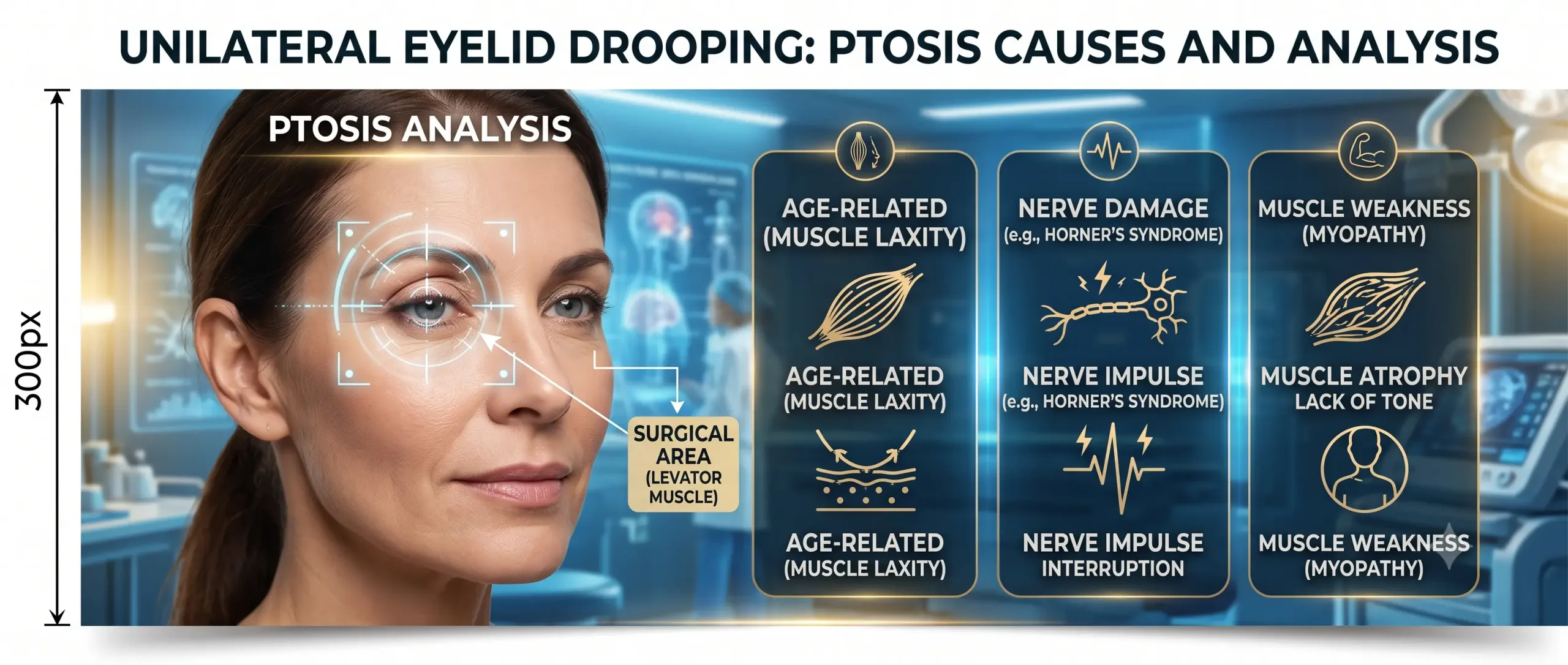
The levator muscle, which is responsible for lifting your eyelid, acts like a rubber band. Over the years, gravity takes its toll. If you have a habit of heavily utilizing one side of your face for expressions, or more importantly, if you consistently sleep on one side of your face, the delicate skin and muscle bindings on that side will stretch and loosen much faster than the other, resulting in a unilateral droop.
Long-Term Contact Lens Use
This is one of the most common, yet least known, causes of unilateral ptosis in the modern world.
If you have been wearing contact lenses for years, the daily mechanical pulling and stretching of your eyelid to insert and remove the lens takes a toll on the levator muscle. Because most people use their dominant hand to pull down or stretch the exact same eyelid every single day, the muscle attachments on that specific eye slowly stretch out of shape, causing the lid to sit lower than the healthy one.
Physical Trauma and Eye Rubbing
A physical impact to the eye area from years ago can show up later in life as a drooping eyelid. Sports injuries, minor accidents, or any blunt force can micro-tear the muscle structure.
Even severe allergies play a role. Aggressively and repeatedly rubbing one itchy eye over a long period can detach the levator muscle from the eyelid cartilage (tarsus), leading to a noticeable asymmetry that only surgery can fix.
Congenital Muscle Weakness (Born With It)
Sometimes, the issue isn’t caused by aging or habits; you were simply born with it. During fetal development, the levator muscle on one side might not develop as fully as the other.
In your teens, the high elasticity of youthful skin might mask this slight weakness. However, as you reach your 20s or 30s and natural collagen production slows down, the weaker muscle begins to struggle against gravity, making the asymmetry highly visible in photographs.
Bad Botox (Toxic Ptosis)
If your single eyelid drooping appeared suddenly within the last few weeks, and you recently had Botox injections in your forehead or crow’s feet area, this is the most likely culprit.
If Botox is injected incorrectly by an inexperienced practitioner, the neurotoxin can migrate into the levator muscle of the eyelid, temporarily paralyzing it. While this is aesthetically frustrating, it is entirely temporary. Once the Botox wears off (usually in 3 to 4 months), your eyelid will return to its normal position.
When Should You Worry? (Neurological Causes)
A drooping eyelid that develops gradually over months or years is almost always an aesthetic and structural issue.
However, if your unilateral droop appears suddenly over a few hours or days, and is accompanied by symptoms like double vision, a smaller pupil on that side, severe headaches, or facial numbness, you must see a neurologist immediately. Sudden unilateral ptosis can be a warning sign of neurological conditions, nerve damage, or stroke.
How to Fix Asymmetrical Eyelids in Turkey
Whether caused by genetics, lens use, or aging, a stretched muscle and excess skin cannot be “tightened” with eye creams or facial yoga. The only definitive solution is a minor surgical correction.
At Op. Dr. Ali Mezdeği’s clinic in Istanbul, we do not need to operate on both eyes if only one is the problem. Using local anesthesia and mild sedation (no general anesthesia required), Dr. Mezdeği delicately removes the excess skin and repairs the loosened muscle on the drooping eye, perfectly matching it to your healthy, natural eye.
The procedure takes only about 30 to 45 minutes. International patients are often amazed that after a quick 3-day stay in Istanbul for tape removal, they can fly back home with a perfectly symmetrical, vibrant, and refreshed gaze.
You Know the Root of Your Asymmetry... Are You Ready to Restore Perfect Harmony?
There is no need to hide from the mirror or the camera because of a single drooping eyelid. With a scarless, 45-minute aesthetic touch under local anesthesia, you can permanently erase that unbalanced expression. Discover the seamless recovery process and why international patients choose Istanbul for their ultimate transformation.