
Breast Augmentation: Submuscular or Subglandular Placement

Breast Augmentation: Submuscular or Subglandular Placement?

Ana sayfa » Blog » Breast Surgery » Breast Augmentation: Submuscular or Subglandular Placement?

You have decided to get a breast augmentation, started your eager research, and keep running into two medical terms: Under the muscle (Submuscular) and Over the muscle (Subglandular). On forums, one group of patients claims, "It definitely needs to be under the muscle; it looks so natural," while another group confuses you entirely by saying, "I had mine over the muscle, felt zero pain, and I love it!"

Let’s clear up the internet misinformation and state the absolute medical truth: In aesthetic surgery, there is no single "best" method for everyone; there is only the "most suitable" method for your unique anatomy. A technique that yielded a fantastic result for your friend might look highly artificial on your chest structure.

So, how does your surgeon decide whether to place the implant above or below your chest muscle? Which method provides a more natural transition in the cleavage area, and what are the differences in the recovery processes?

"If the patient's natural breast tissue and subcutaneous fat layer are thick enough to camouflage the implant, we prefer the over-the-muscle technique. If the tissue is very thin, we opt for under-the-muscle or dual-plane techniques so the edges of the implant are not visible." — Op. Dr. Ali Mezdegi

Let's thoroughly examine the pros, cons, and suitability of these two techniques based on the clinical expertise of Op. Dr. Ali Mezdegi.

Under vs. Over the Muscle: Quick Comparison
📏
Key Decision Factor Patient's Existing Tissue
💧
Natural Look (Thin Patients) Better Under the Muscle
⏱️
Recovery Speed Faster Over the Muscle
🛡️
Sagging Risk Under Muscle Resists Gravity
🏋️‍♀️
Pain Level More Intense First 3 Days (Under)
Modern Approach Dual Plane (Best of Both)

1. What is the Over the Muscle (Subglandular) Technique?

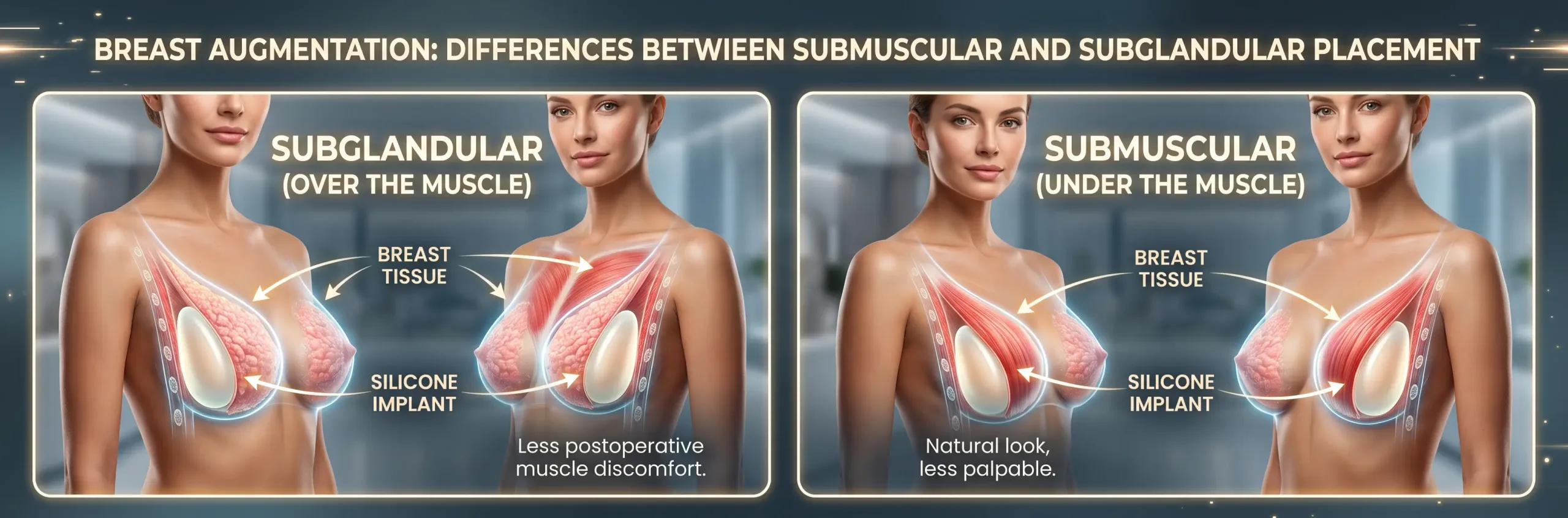
In the over-the-muscle technique, the silicone implant is placed on top of the chest muscle (pectoralis major), directly beneath the existing breast tissue (or fascia). For this technique to be successful and look natural, the patient must have a sufficient amount of natural breast tissue and subcutaneous fat to cover the implant like a thick blanket.

  • Advantages: Because the muscle is untouched, post-operative pain is extremely minimal. The recovery process is very fast; patients can often return to their normal daily lives within a few days. Arm movements do not cause the breast shape to distort.
  • Disadvantages: If the patient is very thin and lacks breast tissue, the edges of the implant may become visible or create a rippling effect under the skin. It also runs the risk of looking artificial, resembling two round balls on the chest.
  • Who is it for? It is ideal for patients who have mild sagging after pregnancy or breastfeeding, but still possess a good amount of natural breast tissue and thicker skin.

2. What is the Under the Muscle (Submuscular) Technique?

In the under-the-muscle technique, the large muscle on the chest wall (pectoralis major) is slightly lifted, and the silicone implant is placed beneath it. Thus, the implant is covered not only by breast tissue and skin but also by a thick layer of muscle.

  • Advantages: It provides a perfect, natural slope in the cleavage area (upper pole); the borders of the implant are completely hidden. Furthermore, because the muscle tissue holds the implant up, the risk of sagging due to gravity over the years is significantly lower.
  • Disadvantages: Because the chest muscle is stretched, muscle pain and arm movement restrictions are more prominent for the first 3-4 days. In professional athletes doing heavy chest workouts, the implant may move slightly when the muscle contracts (animation deformity).
  • Who is it for? This is the absolute go-to method for very thin women with thin subcutaneous fat and practically no natural breast tissue (flat-chested).
The Golden Standard of Modern Surgery: Dual Plane Technique
Today, this is the most advanced and frequently preferred method by Op. Dr. Ali Mezdegi. In this technique, the top half of the implant is placed under the muscle (ensuring a natural-looking cleavage), while the bottom half is placed over the muscle / under the breast tissue (allowing the breast to settle into a natural teardrop slope). It is a miraculous surgical approach that combines the best features of both traditional techniques.

How Should You Choose?

The answer to "Is under the muscle or over the muscle better?" is entirely hidden in your physical examination. Your skin thickness, nipple position, existing tissue volume, and even whether you engage in heavy professional sports directly influence this decision.

During your consultation, your surgeon doesn't just pick a brand of implant or choose between round and teardrop shapes; they map out the most suitable surgical plan for your unique anatomy to ensure a natural result that you will carry proudly for a lifetime.

Frequently Asked Questions: Implant Placement
Compared to over the muscle, there is a stronger sensation of tightness and pressure in the chest muscles for the first 3-4 days. However, with prescribed painkillers and muscle relaxants, this period is managed quite comfortably.
This entirely depends on your body type. If you are very thin with little to no breast tissue, under the muscle (or dual plane) must be chosen for a natural look. If you have enough tissue, over the muscle also looks very natural.
In very thin women, the subcutaneous fat layer is extremely thin. If the silicone is placed directly under the skin (over the muscle), the edges of the implant can become visible, creating an artificial, rippling effect.
No, placing the implant under the muscle does not damage the muscle's function. The muscle is simply lifted and stretched to make room for the implant. Once healed, the muscles continue to function normally.
For professional athletes doing constant heavy chest workouts, the implant might move every time the chest muscle contracts (animation deformity). Therefore, over the muscle or subfascial techniques are often preferred if their anatomy allows it.
It is a modern technique where the top portion of the implant sits under the muscle, and the bottom portion sits over the muscle (under the breast tissue). It provides a highly natural cleavage and a beautiful teardrop shape.
If the implant chosen is too large and the patient's skin elasticity is weak, over the muscle implants can succumb to gravity and sag faster. Under the muscle techniques provide better support against gravity.
If the nipple sagging (ptosis) is very mild, a large implant placed over the muscle or via dual plane can fill the breast out nicely. However, if the sagging is significant, a breast lift (mastopexy) must be performed simultaneously.
Since the muscle tissue is not disturbed in over the muscle (or subfascial) techniques, patients heal much faster and can usually return to desk jobs comfortably within 3-4 days.
Op. Dr. Ali Mezdegi will determine the most accurate surgical technique for you during your consultation. Your personalized surgery plan is mapped out by evaluating your skin thickness, rib cage structure, and aesthetic goals.
Op. Dr. Ali Mezdegi - Plastic Surgeon Istanbul

Author: Op. Dr. Ali Mezdegi

Aesthetic and Plastic Surgery Specialist

With a quarter-century of surgical expertise in breast aesthetics, Op. Dr. Ali Mezdegi is dedicated to providing personalized and lifelong results in Istanbul, Turkey. He prioritizes selecting the most appropriate surgical technique (Submuscular, Subglandular, or Dual Plane) based solely on the patient's tissue thickness, rib cage structure, and skin elasticity rather than a "one-size-fits-all" approach.

🩺
Medical Review & Approval: The content of this surgical guide on "Under the Muscle vs. Over the Muscle Breast Implants" was last updated on August 31, 2026. It has been meticulously reviewed and approved for medical accuracy, anatomical validity, and current surgical standards by Aesthetic and Plastic Surgery Specialist Op. Dr. Ali Mezdegi.