
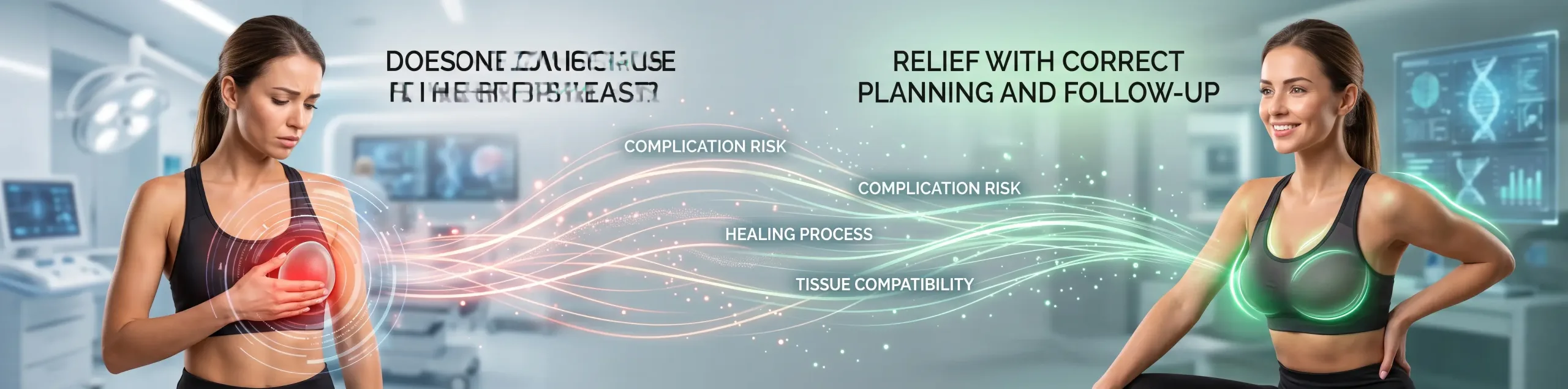
Do Silicone Breast Implants Cause Pain

Do Silicone Breast Implants Cause Pain?

Ana sayfa » Blog » Breast Surgery » Do Silicone Breast Implants Cause Pain?

Are you dreaming of getting breast augmentation surgery (silicone implants) but hesitating because of horror stories you’ve read on internet forums like "I felt like I was hit by a truck," "I couldn't breathe for days," or "Years later, I started feeling sharp, stabbing pains in my breast"?

In aesthetic surgery, the most common concern among patients is pain. Let's put aside the misinformation circulating on the internet and transparently discuss the medical facts.

The truth is: Like any foreign object placed in the body, silicone implants cause stretching in the tissues during the first few days, which leads to a sensation of pressure and soreness rather than sharp pain. However, this pain is certainly not "unbearable." On the other hand, if you experience pain accompanied by hardening in the breast months or years after the surgery, this is not normal and may indicate an underlying medical issue (such as capsular contracture).
"Pain after silicone implant surgery must be divided into two categories: Early-stage pain is a natural sensation of muscle spasm due to stretching, which subsides within 3-4 days. Late-stage pain (occurring years later) can be a sign of a thickened capsule tissue forming around the implant (capsular contracture) and definitely requires medical examination." — Op. Dr. Ali Mezdegi

So, why does the pain level differ between under-the-muscle and over-the-muscle techniques? What should you do to relieve early-stage pain, and most importantly, when should you see a doctor for pain that starts years later? Let's explore the scientific answers to these questions.

Pain After Implants: Quick Facts
🏋️‍♀️
Under Muscle (Early) Muscle spasms & pressure (3-4 days)
💧
Over Muscle (Early) Minimal pain, slight tightness
💊
Early Stage Solution Muscle relaxants & painkillers
⚠️
Pain Years Later Sign of capsular contracture (hardening)
🩺
Late Stage Solution Ultrasound & possible revision surgery
🏃‍♀️
Sports & Movement Restricted for 1 month to avoid pain

1. Early Stage Pain (First Few Days Post-Op)

When you wake up right after the surgery, what you will feel is not a sharp, stabbing pain from the incisions, but rather a significant sensation of pressure, tightness, and heaviness in your chest. The intensity of this pain varies greatly depending on the surgical technique used:

  • Pain with Under the Muscle (Submuscular) Technique: If you are very thin and the implant is placed under your chest muscle for a natural look, it is perfectly normal to feel pain for the first 3-4 days. This is because your chest muscle (pectoralis major) is being stretched to this extent for the first time in your life. Patients often describe this feeling as, "It feels like I did a very heavy chest workout at the gym, and my muscles are incredibly sore." These spasms are largely controlled with muscle relaxants and painkillers, decreasing rapidly after the 4th day.
  • Pain with Over the Muscle (Subglandular) Technique: If you have sufficient natural breast tissue and the implant is placed over the muscle, the postoperative process is extremely comfortable because the muscles are untouched. The pain is almost non-existent; you will only feel some tightness in the skin.

2. Why Does Late Stage Pain (Years Later) Occur?

Months or years have passed since your surgery, everything was fine, and suddenly you start feeling an ache, stinging, or tenderness to the touch in your breast. This is not part of the normal "healing" process and must be evaluated by a plastic surgeon. There are two main medical reasons for pain that begins years later:

  • Capsular Contracture (Hardening in the Breast): Our body perceives the silicone implant as a foreign object and creates a thin membrane (capsule) around it to isolate it. This is completely normal. However, in some patients, for reasons not entirely understood, this membrane thickens, shrinks, and starts squeezing the implant over time. This is called capsular contracture. In advanced stages, the breast becomes as hard as a tennis ball, its shape distorts, and the patient experiences severe pain (a squeezing or stabbing sensation). The solution is a revision surgery to remove this thickened capsule and, if necessary, replace the implant.
  • Implant Rupture: New generation (cohesive gel) silicone implants are manufactured to be highly durable—so strong they won't burst even under immense pressure. However, if an older generation implant tears, or if a tear occurs due to severe trauma (like a car accident or a penetrating injury), pain or a burning sensation accompanied by breast deformity may begin.
Important Note: If the pain in your breasts only begins close to your menstrual period and then goes away, it has nothing to do with your silicone implants. This is a completely natural breast tissue sensitivity due to hormonal changes and water retention (mastalgia), which is experienced by the vast majority of women.

Don't Let Fear Stand in the Way of Your Dreams

In conclusion, the early-stage pain experienced after breast augmentation surgery is temporary, manageable, and a process that is "worth the effort." Pain experienced in the late stages is rare and constitutes a medical condition that can be completely resolved with modern surgical techniques (revision).

Frequently Asked Questions: Implants and Pain

With the under-the-muscle technique, the intense sensation (spasm) due to muscle stretching lasts 3-4 days and then rapidly decreases. With the over-the-muscle technique, the process is much more comfortable, and the pain usually subsides within 1-2 days.
Yes. Especially with under-the-muscle implants, the chest muscle (pectoralis) is stretched, so it is quite normal to experience a stinging sensation in the chest when taking deep breaths, coughing, or laughing during the first few days.
You should take the muscle relaxants and painkillers prescribed by your doctor on time, avoid lifting your arms above shoulder level, and sleep on your back at a slight incline supported by pillows during the first few weeks.
You can immediately perform below-the-elbow movements like eating or brushing your teeth. However, raising your arms high (e.g., reaching for an item on a high shelf) is not recommended for the first 1-2 weeks as it will stretch the chest muscle and cause pain.
Pain that suddenly begins months or years after surgery, accompanied by hardening and deformity in the breast (especially if one-sided), is usually a sign of membrane thickening known as "capsular contracture." It should be examined by a surgeon.
Silicone implants do not increase menstrual pain or cause extra pain. The soreness and tenderness felt during this period are entirely due to your natural breast tissue retaining water hormonally (mastalgia).
New generation cohesive gel silicones do not tear easily. However, if it ruptures due to a severe accident, you may experience a stinging or burning type of pain, along with shape deformity and swelling in the lymph nodes.
Yes. Doing sports that work the chest muscles, such as weightlifting, push-ups, pull-ups, or swimming within the first month, will lead to severe muscle spasms and pain. Upper body exercises should be started slowly only after the 6th week.
No, because capsular contracture is physically thickened tissue around the implant, it cannot be permanently cured with painkillers or massage. The definitive solution is surgical intervention (revision) to remove this hard capsule.
Saying "zero pain" is not medically accurate. However, because the muscle is not cut or stretched, the pain is almost negligible compared to the under-the-muscle technique. The patient usually only feels a slight ache due to skin tightness.
Op. Dr. Ali Mezdegi - Plastic Surgeon Istanbul

Author: Op. Dr. Ali Mezdegi

Aesthetic and Plastic Surgery Specialist

In his quarter-century surgical career, Op. Dr. Ali Mezdegi places patient safety and comfort at the center of his practice. He is dedicated to minimizing postoperative pain by using modern, tissue-sparing techniques in breast augmentation, while also providing permanent medical solutions for international patients facing complex revision cases like capsular contracture.

🩺
Medical Review & Approval: The content of this patient guide on "Do Silicone Breast Implants Cause Pain?" was last updated on September 4, 2026. It has been meticulously reviewed and approved for postoperative physiology, complication management, and medical accuracy standards by Aesthetic and Plastic Surgery Specialist Op. Dr. Ali Mezdegi.